


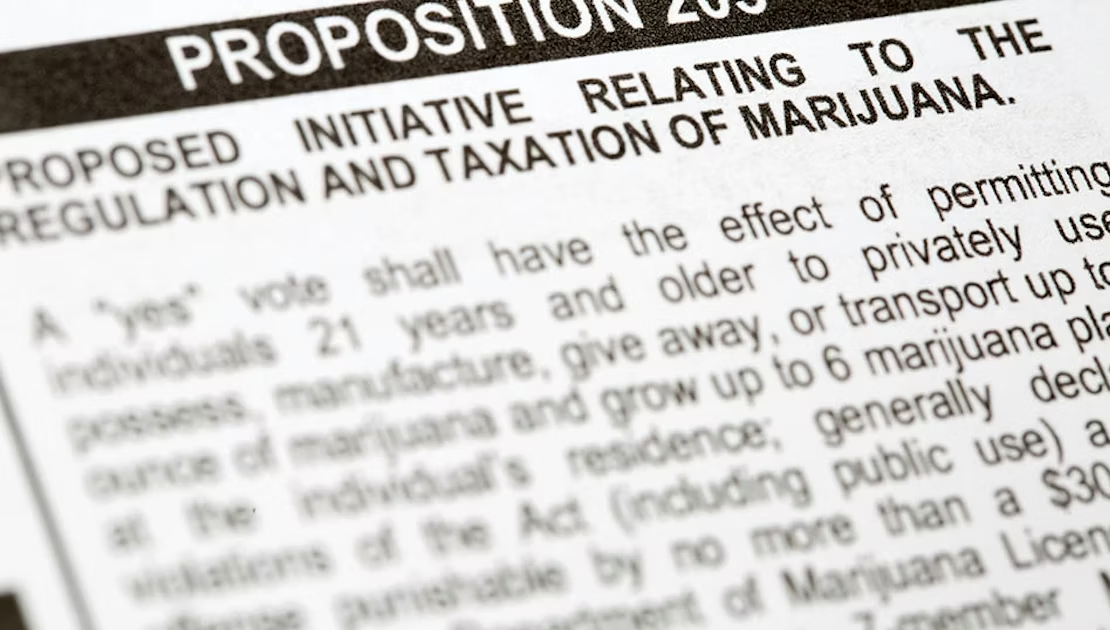
The financial advantages of cannabis tax revenues have frequently been utilized to encourage state lawmakers and voters to back legalization initiatives across various states. Excise taxes on cannabis can contribute to funding for schools, childcare programs, law enforcement, environmental initiatives, youth substance abuse prevention, social equity and justice, job creation, public health, and much more. As we look back over a decade since Colorado and Washington legalized adult-use cannabis, many fears surrounding prohibition have been proven unfounded. For instance, a report revealed that the rate of Colorado high school students who reported using cannabis remained statistically stable at around 36.9% in 2013 to 35.9% in 2019.
In Washington, with a 37% excise tax on adult-use cannabis—alongside a 6.5% sales tax and approximately 2.9% local tax—the state collected over $3 billion in taxes from cannabis businesses within the last five years. The revenue generated has primarily funded the state’s Medicaid program, as well as general fund allocations and substance abuse prevention programs.
Complex Tax Structures Across States
In California, the state imposes a 15% excise tax on retail sales, complemented by a sales tax that varies between 7.25% and 10.75% based on municipal regulations. In certain areas, local governments even impose additional taxes on cultivators based on the size of their cultivation operations. For example, Sonoma County charges cultivators $7.58 per square foot for indoor grows and varying rates for mixed light and outdoor operations. Since adult-use sales began in 2018, California has collected roughly $7 billion in state taxes from the cannabis sector.
While the California Department of Tax and Fee Administration (CDTFA) recently permitted tax relief for businesses affected by the Los Angeles County wildfires, business leaders expressed uncertainty about who would qualify for such assistance. Many industry insiders believe that local authorities have treated cannabis businesses as a convenient revenue source without accountability for how the tax revenues are utilized.
In Colorado, the state applies a 15% excise tax at both retail and wholesale levels. Other states like New York, Illinois, and Connecticut have introduced a THC “potency tax” along various points in the supply chain. New York’s adult-use cannabis program, for instance, applies a 13% excise tax at retail, along with a potency tax for distributors ranging from $0.03 per milligram of THC for edibles to $0.005 per milligram for cannabis flower.
Legislative Developments and Their Impact
As of 2025, a mere 27.3% of U.S. cannabis businesses report profitability, compared to 65.3% of small businesses in general, according to data from Whitney Economics. Nonetheless, state officials continue to treat the cannabis industry as a reliable source of tax revenue. Despite cannabis businesses being deemed “essential” during the COVID-19 pandemic, punitive tax rates persist, pushing consumers toward unregulated markets.
In California, the cannabis excise tax rate is set to rise from 15% to 19% starting July 1, 2025, due to legislation signed by Governor Gavin Newsom. Critics contend this tax hike will exacerbate challenges for the legal market. Similarly, in Maine, Governor Janet Mills has proposed increasing the cannabis excise tax by 4% to address a budget shortfall.
In Mississippi, regulatory adjustments aim to include medical cannabis sales in the state Department of Revenue’s excise tax framework, even as taxing prescription medications typically faces scrutiny. In Montana, concerns are mounting that proposed legislative actions may divert funds from the state’s 20% cannabis excise tax away from conservation initiatives and into other areas.
Conclusion
As the national conversation around cannabis excise taxes evolves, many lawmakers and beneficiaries of cannabis tax revenues seem to overlook one of the fundamental goals of legalization: ensuring public health and safety through regulated products available from licensed businesses. However, escalating tax rates risk driving consumers away from licensed dispensaries, undermining the very objectives that legalization intended to achieve.
