


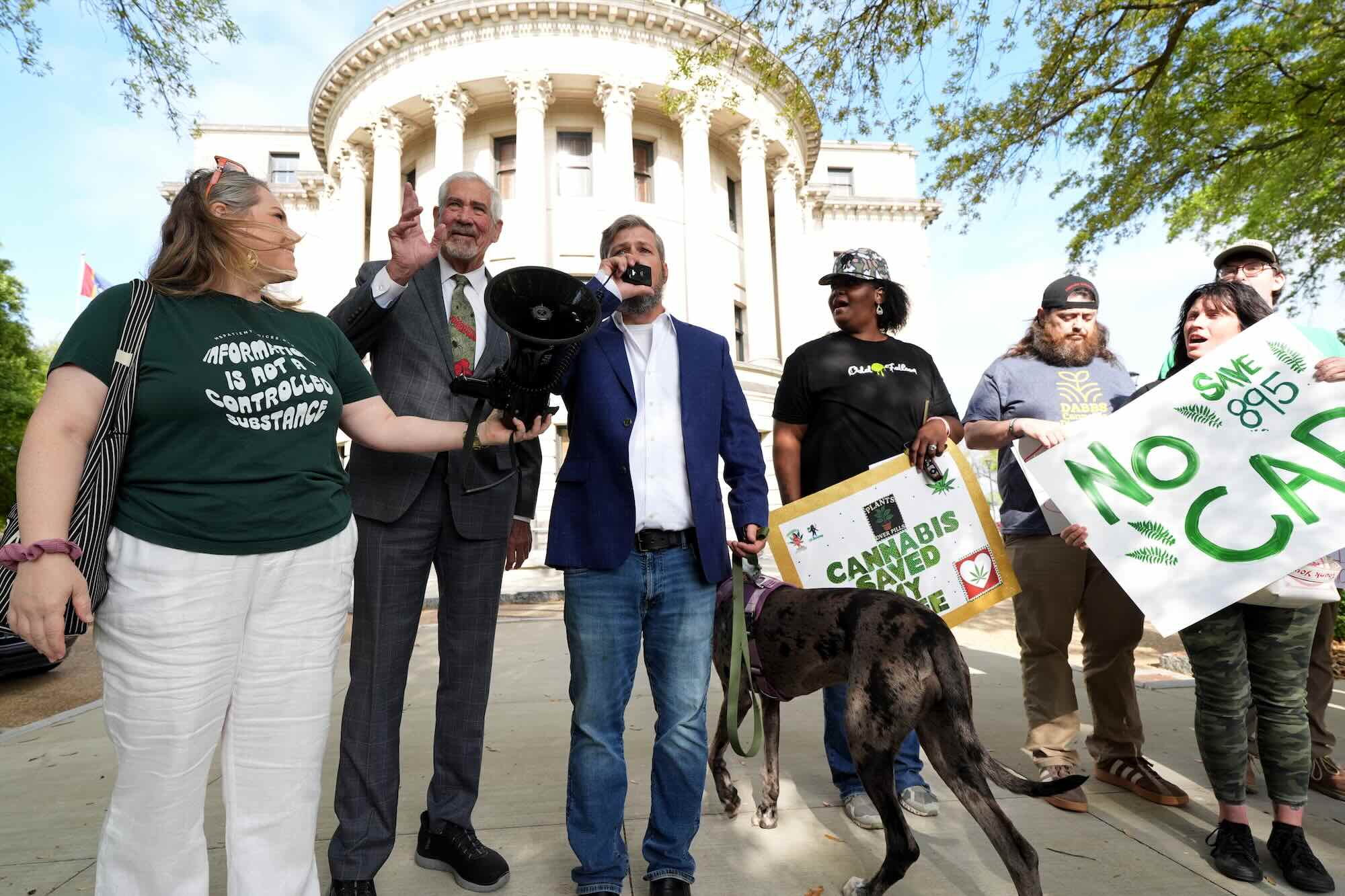
JACKSON, Miss.—Mike Watkins, a medical cannabis patient and consultant from Mississippi, engaged attendees with hugs and high-fives while leading a gathering of protesters advocating for medical cannabis outside the Capitol Building on Monday morning.
Approximately 100 individuals, including medical cannabis patients, practitioners, industry workers, caregivers, and advocates, convened to protest after Governor Tate Reeves vetoed two pivotal medical cannabis bills on March 26: House Bill 1152 and House Bill 895. Supporters of the bills argued that their enactment would enhance access to the state’s medical cannabis program; however, Reeves stated in his veto messages that the bills exceeded the program’s intended scope.
In response to the veto, Watkins promptly issued a call to action on Facebook on March 27, inviting fellow medical cannabis patients, caregivers, industry workers, and advocates to join a peaceful protest aimed at persuading the Mississippi Legislature to reconsider the bills for a veto-proof majority approval.
Legislative Support and Call for Advocacy
During the protest, advocates within the Legislature, Representative Lee Yancey and Senator Kevin Blackwell, made brief appearances. Watkins expressed gratitude for their support, urging attendees to contact legislators who opposed the medical cannabis bills, recognizing that Yancey and Blackwell were advocating on their behalf.
“We’ve got to sell it to everyone else,” Watkins stated. He encouraged the crowd to recognize the significance of their cause: “This is a worthy cause, an easy win, and I believe we can get the votes, but you’ve got to put in the work.”
Watkins, a U.S. Army veteran, led the protest alongside his service dog, a Great Dane-Bull Mastiff mix named Brooklyn Rza, and Elizabeth Feder-Hosey, the Founder of Mississippi Patient Voices.
Feder-Hosey highlighted the unity among those present, commenting, “This has been the ultimate team effort, and I think this year we can see what the legislative session can be when we’re all together.” She noted that while Mississippi currently has around 68,000 medical cannabis patients, nearly one-third of the population—approximately 984,000—could potentially qualify for a patient card.
“We just haven’t reached them yet,” she added.
Public Support for Medical Cannabis Legislation
During the protest, Gulf War veteran Devereaux Galloway reminded the crowd that 74% of Mississippians voted in favor of instituting a medical cannabis program via Initiative 65 in 2020. Over one million votes were cast in support of legalizing medical cannabis through both Initiative 65 and its stricter counterpart, Initiative 65A. In 2021, the Mississippi Supreme Court invalidated the ballot-initiative process, thereby nullifying the medical cannabis program; however, the Legislature enacted the Mississippi Medical Cannabis Act in 2022.
“Your power is in November,” Galloway urged the crowd, reinforcing the bipartisan nature of their initiative. “It’s not about race, gender, or ethnicity—it’s about the 74%.”
Overview of Vetoed Bills
House Bill 895 proposed extending the renewal period for medical-cannabis caregiver cards from one year to two years. Furthermore, it eliminated the requirement for doctors to conduct mandatory six-month follow-ups for medical cannabis patients. This change would shift the responsibility for follow-up visits to the discretion of individual doctors.
The bill also sought to remove the 60% potency cap on medical cannabis concentrates, allowing patients to purchase stronger products without legislative limitations. Reeves justified his veto of H.B. 895, citing the success of the existing Mississippi Medical Cannabis Act in providing essential treatment options for patients.
“House Bill 895 seeks to erode three important safeguards contained in the Act,” Reeves stated. These included the mandatory follow-up visits, caregiver background checks, and the THC potency cap. He emphasized that these measures served as crucial checks to prevent the diversion of medical marijuana for recreational use.
Currently, concentrates, which can have potency levels between 90-100%, must be diluted by Mississippi cultivators to comply with state law, resulting in patients needing to use larger quantities for effective relief.
Future Legislative Steps
Representative Lee Yancey, the author of H.B. 895, directed the bill back to the House Business and Commerce Committee. While legislators have the option to override the governor’s veto, this requires a two-thirds majority vote in both chambers. Yancey expressed appreciation to the demonstrators, stating, “We are trying to decide what our next steps are.” He noted that with less than a week remaining in the legislative session, urgency is critical.
Regulatory Balance and Patient Access
H.B. 1152 aimed to expand the program by allowing individuals without qualifying conditions to access medical cannabis, pending approval from the Mississippi State Health Officer, Dr. Dan Edney. An amendment proposed allowing out-of-state residents the same access under specific conditions, which Reeves cited as a reason for vetoing the bill, asserting it exceeded the legislation’s original intent.
“The amendment making out-of-state residents eligible for the program shifts the intent of the bill away from helping Mississippians with dire conditions,” Reeves quoted Edney as saying. “This policy position was clearly communicated, and we could only support narrowly defined language that does not lean toward recreational use.”
Reeves reiterated his willingness to support a version of the bill limited to Mississippi residents with chronic conditions, should it be resubmitted in its original form. The House has since referred the bill back to the House Public Health and Human Services Committee for further consideration and a potential path towards passing it with a two-thirds majority.
